
The thin plastic sheeting is an essential material used across various industries, including packaging, textiles, and medical devices. Understanding its mechanical properties, particularly its tensile strength and elongation behavior, is crucial for material selection, production quality, and end-use performance. One of the most effective methods for determining these properties is through the test rozciągania i wydłużenia. This article will provide an in-depth understanding of the test method, explain the key parameters, and discuss the relevance of ASTM D882 standards for evaluating thin plastic sheeting.
Why ASTM D882 is Crucial for Thin Plastic Sheeting Testing
The ASTM D882 standard defines the test method for determining the tensile properties of thin plastic films and sheeting. This method is essential for evaluating materials used in various applications, ensuring they meet the necessary strength and performance criteria.
The test rozciągania i wydłużenia conducted according to ASTM D882 helps characterize the plastic film’s resistance to stretching forces, which is particularly relevant in packaging applications where films are often stretched and deformed under stress.
Key Concepts in Tensile and Elongation Testing
The test rozciągania i wydłużenia measures how much a thin plastic sheet can stretch (elongation) before it breaks (tensile strength). The test is conducted using a mechanical testing machine that applies a uniform force to a specimen of plastic film. As the force increases, the material elongates, and the test continues until the film ruptures.
From this process, three critical properties are calculated:
- Wytrzymałość na rozciąganie: Maksymalne naprężenie, jakie materiał może wytrzymać przed pęknięciem.
- Elongation at Break: The percentage by which the material elongates before failure.
- Modulus of Elasticity: A measure of the stiffness of the material.
These properties are vital for determining the durability and flexibility of the plastic film, ensuring it performs as required in various applications.
Testing Procedure for Thin Plastic Sheeting Tensile and Elongation
To conduct an accurate test rozciągania i wydłużenia, several preparation steps and conditions must be followed:
Data Collection: The machine records the force and elongation until the specimen breaks. The wytrzymałość na rozciąganie is determined by measuring the maximum force before rupture, while the elongation at break is the amount of stretching the material underwent before failure.
Specimen Preparation: A uniform strip of plastic sheeting is prepared, typically with a standard width and length. The specimen must be free of defects, and edges should be smooth to ensure consistent results.
Test Setup: The prepared specimen is securely placed between the grips of the tensile testing machine. The test is performed at a controlled speed and environmental conditions to ensure reliable data.
Application of Force: The machine applies force at a constant rate, stretching the specimen. The force and extension are recorded during the process.
Importance of Tensile Strength and Elongation in Thin Plastic Sheeting
The tensile strength analysis of thin plastic sheeting helps manufacturers and engineers understand how the material will behave under stress. For example:
- Packaging materials often need to resist tears and punctures. A higher tensile strength indicates that the material can withstand more force before breaking.
- Materials used in medical devices must be flexible yet strong. Elongation at break is a critical factor here, as the material must stretch without tearing.
Additionally, the moduł sprężystości can reveal how stiff the material is. Films with low modulus values are flexible, while those with high values are more rigid. This is important for selecting the right material for different applications.
ASTM D882: The Standard for Tensile Testing
ASTM D882 outlines the parameters and procedure for performing the test rozciągania i wydłużenia on plastic films. It provides standardized methods to ensure accuracy and repeatability in test results. The test can be performed under various conditions to simulate real-world usage and material behavior in specific environments, such as heat or humidity.
Practical Considerations and Equipment for Tensile Testing
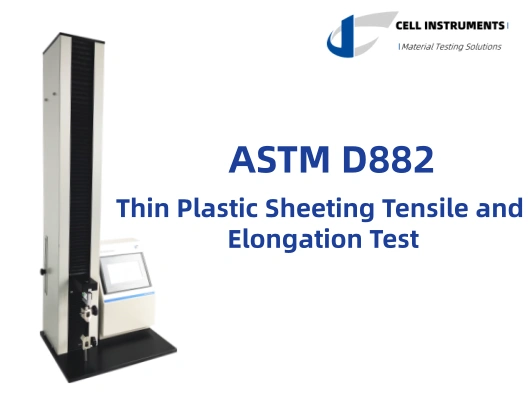
The Cell Instruments Tensile Tester TST-01 is an ideal tool for performing tensile and elongation tests on plastic sheeting. It offers:
- Precise control over test speed and force application.
- A versatile setup that accommodates different specimen sizes and thicknesses.
- User-friendly interface for easy operation and data analysis.
Using reliable and calibrated equipment such as the TST-01 ensures that the results are consistent, accurate, and in compliance with ASTM D882.
Conclusion
Understanding the tensile and elongation properties of thin plastic sheeting is crucial for ensuring that the material meets the required performance standards. By conducting tests in line with ASTM D882, manufacturers and quality control personnel can gain essential insights into the behavior of plastic films under stress. This knowledge is critical for making informed decisions about material selection, process optimization, and ensuring product durability.
By following standardized testing methods, you can be confident that your tensile strength analysis provides valuable, reliable data that supports the performance and quality of your plastic films in real-world applications.
 PL
PL  EN
EN  AR
AR  BG
BG  CS
CS  DA
DA  DE
DE  EL
EL  ES
ES  ET
ET  FI
FI  FR
FR  HU
HU  ID
ID  IT
IT  JA
JA  KO
KO  LT
LT  LV
LV  NB
NB  NL
NL  PT
PT  RO
RO  RU
RU  SK
SK  SL
SL  SV
SV  TR
TR  UK
UK