
Medical films are widely used in packaging, wound care, and sterilization processes. Their durability, flexibility, and strength are critical to ensuring product safety and performance. To guarantee these characteristics, a tensile strength test is performed to measure the mechanical properties of medical films, providing essential data for quality control, material selection, and engineering design.
By understanding the tensile properties of medical films, manufacturers can ensure that their products withstand handling, shipping, and application stresses while maintaining functionality. This article will guide readers through the test method, its significance, and practical considerations for accurate testing.
Tensile Strength Test: Purpose and Importance
Stránka tensile strength test evaluates the maximum force a material can withstand before breaking, as well as its elongation, modulus of elasticity, and toughness. For medical films, these properties are crucial because they influence:
- Durability: Ensuring films do not tear during handling or sterilization.
- Flexibility: Allowing films to conform to irregular surfaces without damage.
- Stiffness and Toughness: Supporting medical packaging processes and machinery without failure.
Stránka ASTM D882 standard provides a widely accepted procedure for performing tensile tests on thin plastic films, including medical films. Adherence to this standard ensures that results are reliable, reproducible, and comparable across different materials and laboratories.
Tensile Strength Test Procedure
Vykonávanie tensile strength test on medical films involves several critical steps:
1. Príprava vzorky
Prepare uniform specimens with consistent thickness and width, as variations can significantly affect results. Medical films should be cut carefully to avoid edge defects, which may lead to premature failure.
2. Mounting the Specimen
Mount the specimen in a mechanical testing machine using grips designed to prevent slippage or tearing at the clamping points. Depending on the film’s elongation and thickness, different grip types and separation distances may be required.
3. Applying the Tensile Load
The testing machine stretches the film at a controlled speed while continuously recording force a extension. The rate of strain must be standardized according to ASTM D882 to ensure reproducibility.
4. Recording Data
During testing, the machine captures the force-extension curve. Key properties calculated from this data include:
- Pevnosť v ťahu: Maximum stress before rupture.
- Elongation at Break: Percentage increase in length before failure.
- Tensile Modulus of Elasticity: Stiffness of the film.
- Tensile Energy to Break (TEB): Total energy absorbed up to rupture.
5. Analyzing Results
Evaluate the recorded data to determine if the medical film meets the required mechanical specifications. Compare results with standards, historical data, or competitor materials to assess quality and suitability.
Significance of ASTM D882
ASTM D882 specifies conditions, specimen dimensions, and testing procedures for thin plastic films, ensuring that the tensile properties obtained are consistent and meaningful. By adhering to this standard:
- Comparisons between materials and batches are accurate.
- Testing accounts for specimen thickness, grip type, and strain rate.
- Data supports both quality control and R&D applications.
The test is particularly valuable for:
- Material Characterization: Determining mechanical behavior for product design.
- Process Optimization: Ensuring films can withstand production stresses.
- Quality Assurance: Identifying weak batches before release.
Practical Considerations for Accurate Testing
To achieve reliable results during tensile strength testing of medical films, pay attention to:
- Environmental Conditions: Temperature and humidity can affect film properties.
- Specimen Uniformity: Ensure consistent thickness and absence of defects.
- Machine Calibration: Verify that the tensile tester is correctly calibrated.
- Data Interpretation: Consider that films failing by tearing may produce anomalous data.
Using the Cell Instruments TST-01 Tensile Strength Tester
For precise and efficient testing, the Cell Instruments TST-01 Tensile Strength Tester is highly recommended. Its features include:
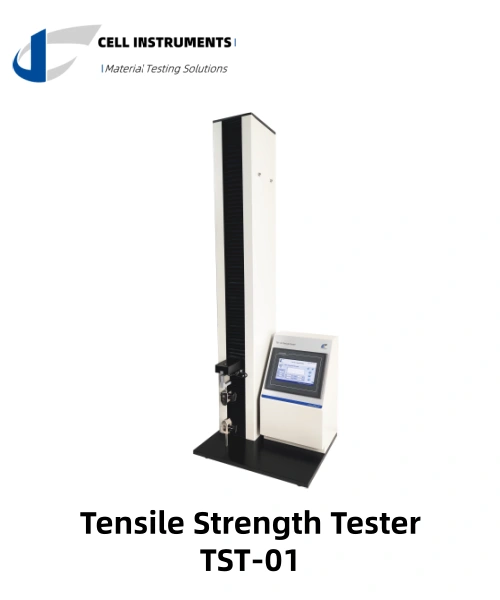
- Accurate Force Measurement: Records maximum tensile stress and elongation with high precision.
- Adjustable Grips: Suitable for a variety of film thicknesses.
- ASTM D882 Compliance: Ensures results meet industry standards.
- User-Friendly Interface: Simplifies setup, testing, and data analysis.
The TST-01 helps manufacturers monitor medical film quality, optimize production, and ensure compliance with mechanical specifications.
Conclusion
Vykonávanie tensile strength test on medical films is essential to guarantee their durability, flexibility, and overall performance. Following ASTM D882 procedures provides reliable, standardized results, supporting quality control, R&D, and engineering design. Using advanced equipment like the Cell Instruments TST-01 Tensile Strength Tester ensures precise and repeatable measurements, enabling manufacturers to deliver high-quality medical films for critical applications.
 SK
SK  EN
EN  AR
AR  BG
BG  CS
CS  DA
DA  DE
DE  EL
EL  ES
ES  ET
ET  FI
FI  FR
FR  HU
HU  ID
ID  IT
IT  JA
JA  KO
KO  LT
LT  LV
LV  NB
NB  NL
NL  PL
PL  PT
PT  RO
RO  RU
RU  SL
SL  SV
SV  TR
TR  UK
UK